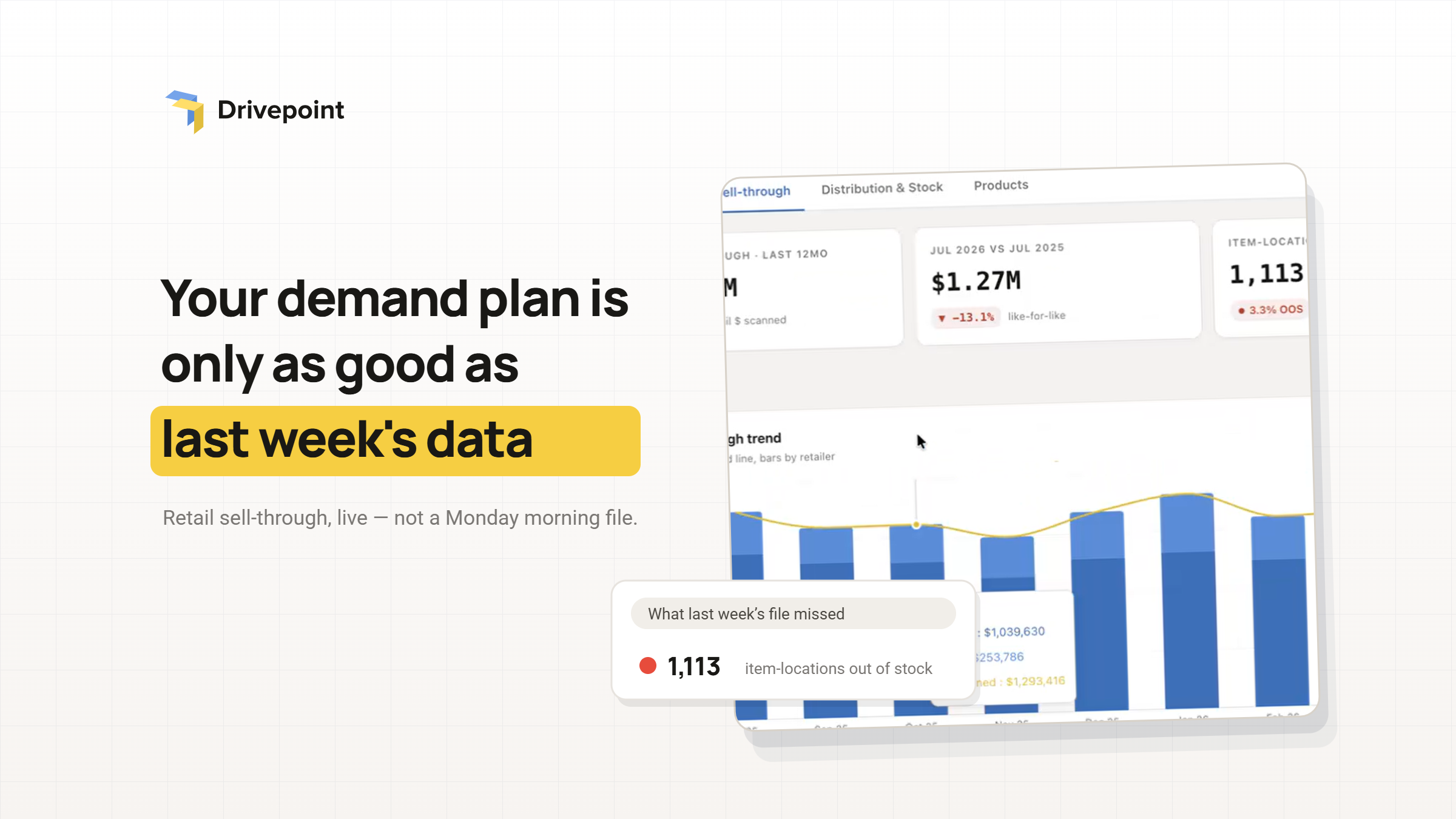

Every consumer brand runs on a weekly cycle it did not choose. The retailer report drops Monday at 6am. By 9am the ops team has set the KPIs for the week. That one file dictates the forecast. And if the person who pulls it is on vacation, the whole week runs on last week’s assumptions.
Some brands do not even get a weekly cycle. SEEQ was forecasting quarterly, sometimes annually, working from data that ran 30 to 60 days behind, while running nationwide Target distribution alongside DTC, Amazon, and TikTok Shop. Their published story names what that cost them: stockouts and marketing overspend. Both at once, in the same business, for the same reason.
Demand planning for a consumer brand is the work of turning what actually sold into what you produce next, then into the cash and capacity required to produce it. Every step in that chain depends on the step before it. Which means the quality of your demand plan is capped by the freshness of your retail data, no matter how good the model on top of it is.
Demand planning is a chain, and retail data is link one
The sequence is not complicated. Sell-through tells you what is moving. What is moving tells you what to produce. What you produce tells you what cash you need and when you need it.
Break link one and every number downstream is a guess with good formatting. The model still calculates. The charts still render. The board deck still looks credible. It is just describing a business that does not exist.
This is the part most planning conversations skip past. Teams spend months choosing a planning tool and almost no time on whether the data feeding it arrives fast enough to matter. We wrote separately about why retail data is so hard to get and normalize in the first place. This post assumes you have solved that and asks what you do with it.
What shipped is not what sold
Here is the distinction that quietly breaks most planning models.
Your ERP knows what left your warehouse. It does not know what left the shelf. Those are different numbers, separated by however many weeks of inventory are sitting at the retailer, and they diverge exactly when it matters most: during a launch, after a promotion, or when a buyer over-orders and then goes quiet.
Plan against shipments and you are planning against your own past decisions rather than against demand. You will reorder because you shipped a lot last quarter, not because anyone bought it.
immi is the cleanest published example of what happens when the forecast catches up to reality. Their expansion into wholesale brought inventory requirements that DTC never demanded, and once the forecasting caught up they cut actual-versus-budget variance by 50%. That is not a modeling improvement. That is the same model finally pointed at the right inputs.
The bottleneck usually is not planning skill
It is data assembly time, and the cost lands on the wrong person.
The clearest illustration in our customer library comes from Ibex, and it lands because of who said it. Andrew Bridgers is their Director of Supply Chain and Planning. His point is that without the right tooling, he would have spent almost half his week building financial models.
Sit with that for a second. Two days a week of the person whose actual job is planning supply, spent assembling the inputs to plan supply. Ibex avoided $314,000 in annual finance personnel costs and grew revenue 77% year over year once that time came back.
When brands say their demand planning is weak, the diagnosis is usually assumed to be a skills gap or a tooling gap. More often it is a plumbing problem wearing a planning problem’s clothes.
What a real planning system needs on top of the data
Clean retail data is necessary and not sufficient. A planning system that anyone will actually use needs four things layered on top:
- Growth assumptions you can switch between. Conservative, base, and aggressive, side by side, not three separate workbooks that drifted apart in March.
- Seasonality curves that match your category. Flat, holiday-dipped, summer-weighted. A single annual growth rate spread evenly across twelve months is not a forecast, it is an average.
- Production caps and floors. What you should make is bounded by what you can make. A plan that ignores capacity produces a number nobody in operations can act on.
- An open-to-buy forecast at the individual product level. Not category level. The reorder decision happens per SKU, so the forecast has to happen per SKU.
The part that matters most is that these are live model inputs, recalculating as assumptions change. A scenario someone built once in March and saved as a PDF is a historical document by April.
Here is what that looks like running against normalized retail data:
The operations view. Growth cases, seasonality, capacity constraints, and an open-to-buy forecast, all recalculating against live retail data.
Stockout risk, computed instead of estimated
Weeks of supply and out-of-stock store counts are genuinely hard to calculate by hand across multiple retailers. Different reporting grains, different inventory visibility, different refresh schedules. So most brands eyeball it, flag the SKUs that feel risky, and hope.
With the retail layer normalized, it stops being an exercise and becomes a query. You can ask which products are under four weeks of supply, at which accounts, and rank them by revenue exposure.
Slumber Cloud is the published version of this. They run SKU-level inventory forecasting at 90% accuracy, and their stated goal is the right one: preventing overstock and stockouts, not just one or the other. Most brands optimize against a single failure mode and get blindsided by the opposite one.
If weeks of supply is still a manual exercise at your brand, our inventory roll-forward and weeks of supply template is a reasonable place to start while you sort out the data layer.
The outcome worth avoiding is specific: your product flying off the shelf with nothing behind it. That risk compounds when lead times are long, or when you are waiting on the retailer to place the order before you can commit to production.
Close the loop back to the model
Knowing you have a supply problem is only useful if you can price the fix.
Oats Overnight is the best story in our library for this, partly because they manufacture in house, so capacity is a real constraint rather than a vendor conversation. They believed delaying a facility expansion was the cost-efficient move. The model showed the delay was a $4M missed opportunity against the Q4 surge.
They built sooner, hit the surge, and closed a $20M Series A with 98% forecast accuracy behind them. Nina McKinney, their Chief Strategy Officer, framed the turning point precisely: they understood the upside conceptually, but it took seeing the P&L impact in the model to understand the time urgency.
That is the full loop. Retail data tells you what sold. The plan tells you what to produce. The model tells you what producing it does to your P&L and your cash. Each step is only as good as the one feeding it.
The uncomfortable version
Most demand plans are not wrong because the math is wrong. They are wrong because the inputs were two weeks stale when the math ran, and nobody re-ran it.
A demand plan built on stale retail data is not a plan. It is a well-formatted opinion.
Giving operations the same live retail data finance already sees is the fix — that is what Drivepoint for Operations is built to do.
Demand planning questions, answered
What is demand planning for a CPG brand?
Demand planning is the process of turning what actually sold into what you produce next, and then into the cash and capacity required to produce it. For a consumer brand selling through retail, that means starting from retailer sell-through rather than your own shipments, applying growth and seasonality assumptions, respecting production capacity, and producing a reorder or open-to-buy forecast at the SKU level. Every step depends on the freshness of the step before it.
Why can't you plan demand from ERP shipment data?
Your ERP knows what left your warehouse, not what left the shelf. Those two numbers are separated by however much inventory is sitting at the retailer, and they diverge most during launches, after promotions, and when a buyer over-orders then goes quiet. Planning against shipments means planning against your own past decisions rather than actual demand, which is how brands reorder into a channel that has already stalled.
What is an open-to-buy forecast?
An open-to-buy forecast tells you how much inventory you can commit to purchasing or producing in a given period, given expected sell-through, current stock position, and any capacity limits. For consumer brands it has to run at the individual product level rather than by category, because the reorder decision itself happens per SKU. Useful versions recalculate live as growth and seasonality assumptions change instead of being rebuilt from scratch each cycle.
How do you calculate weeks of supply across multiple retailers?
Weeks of supply is on-hand units divided by average weekly sell-through. The difficulty in retail is not the formula, it is that each retailer reports inventory and sales at different grains, on different refresh schedules, and with different product identifiers, so the inputs have to be normalized before the division means anything. Once the retail data sits in one modeled layer, weeks of supply and out-of-stock store counts become a query rather than a manual exercise.
How often should a consumer brand reforecast demand?
As often as the underlying retail data refreshes, which for most accounts means weekly. Brands forecasting quarterly on a 30 to 60 day reporting lag are making inventory and marketing commitments against numbers up to two months old, and the cost shows up in both directions at once as stockouts on the products that are moving and overspend on the ones that are not.