
For most of my career, finance has run in the same loop.
Someone asks a question. What happened to margin last month? Which channel is actually carrying us? Can we afford this PO? And before anyone can answer, the real work starts. Find the data. Clean it. Build the model. Structure it so it can even hold the question. Then, finally, an answer.
By the time the answer shows up, the meeting is over and the decision already got made on a gut feel.
I have watched this play out across close to a hundred consumer brands, from five million in revenue to nearly a billion. The pattern is identical at every size. The best operators are not the ones with the fanciest models. They are the ones who get to a trustworthy answer fastest. Everyone else is stuck in prep.
Here is what I have come to believe: the prep was never the job. The prep was the tax you paid to do the job. And that tax is about to go to zero.
The order is reversing
The old order was: know the question, build the model, get the answer.
You had to know exactly what you were going to ask before you could ask it, because building the model was expensive. So you front-loaded everything. You guessed at the questions leadership might throw at you and built for those. Anything off-script meant another day of work.
The new order is: ask the question, get the answer, then decide what to ask next.
That sounds small. It is not. When the cost of asking drops to almost nothing, you stop rationing questions. You follow the thread. Gross margin dipped? Why. Which channel. Which SKU. Was it promo or was it freight. You can chase all of it in one sitting, out loud, in the room, instead of booking a follow-up for next week.
What this looks like in practice
A founder asks what gross margin was last month. The answer comes back in seconds: 43%. Not a guess, the real number. She opens the model and verifies it live before she believes it. It holds up.
From there she keeps going. How does that compare to the same month last year. Which channel dragged it. What does cohort profitability look like by first product. What is Whole Foods velocity doing. All in one session, with no new model built for any of it.
None of those were planned questions. They came up because the last answer suggested the next one. That is what it feels like when the prep step disappears. You are not running a report. You are having a conversation with your business.
See it happen
Enough words. Here are two of them, both real, each built in a single prompt.
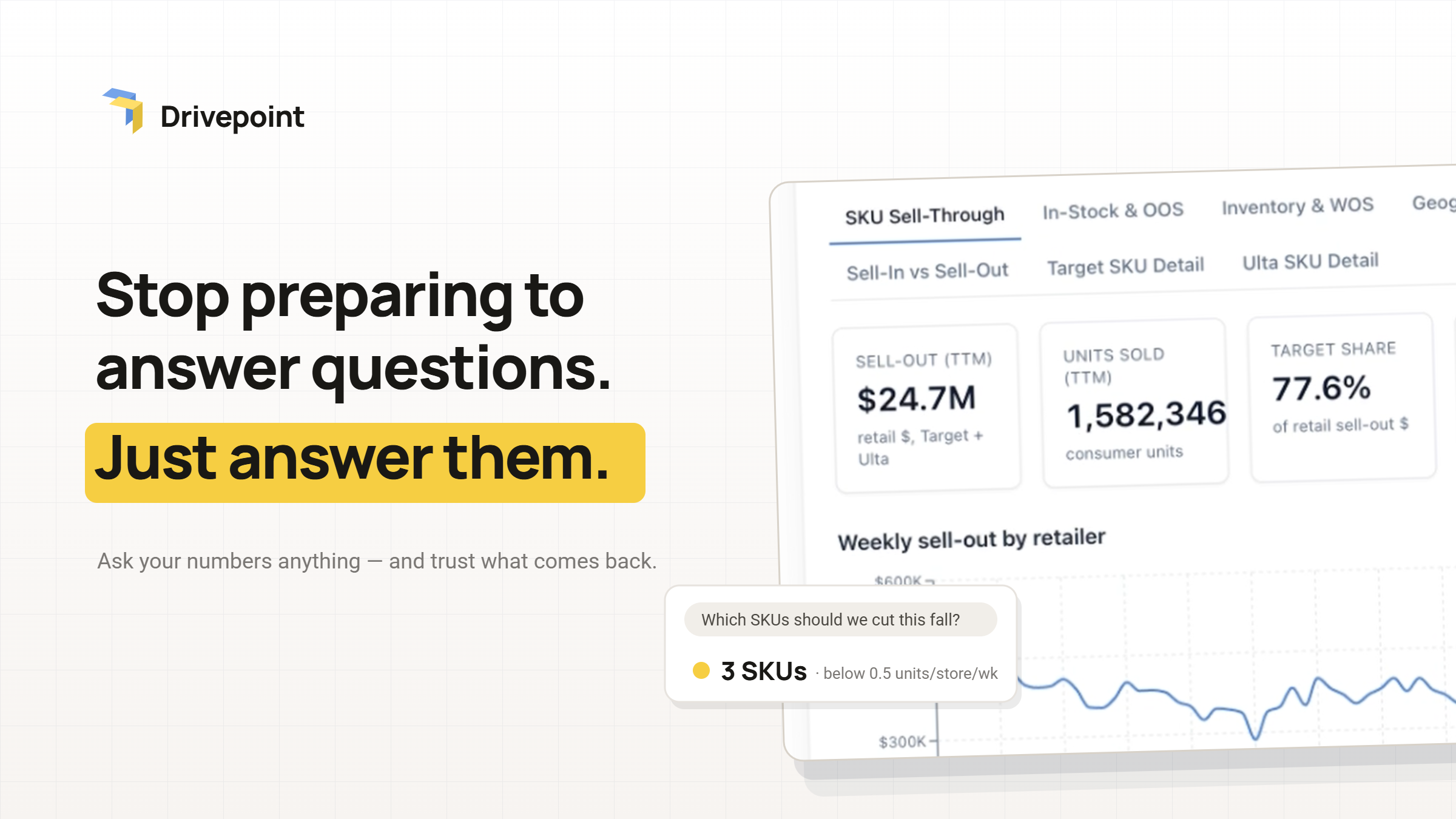
This is the question a channel or ops lead used to file a ticket for. Sell-through and velocity by retailer, pulled together and read out loud, with no report built first. Watch how fast it goes from how are we doing at retail to something you could take into a buyer meeting.
This is the one I open every morning. Sales and trend, week over week and month over month, the state of the business in the time it takes to pour coffee. Nobody assembles it. You ask, it is there.
The point of both is not the specific report. It is that the report was never the hard part. The hard part was getting to it, and that part is gone.
This is a data problem, not an AI problem
Here is the part people get wrong. They think it is the AI. It is not. Every team has access to the same models now. Using AI is quickly going to be like saying you use the internet. It will not set you apart.
What matters is what the AI is allowed to touch.
Point a model at raw, unreconciled data and it will confidently make something up. A channel that does not exist. A margin that is off by ten points. That is the experience that made most finance leaders stop trusting AI in the first place, and they were right to stop.
The fix is unglamorous. It is a clean, vetted data layer underneath the model: raw, cleaned, segmented, finished. The model queries the finished layer, so it reproduces the right number instead of inventing one. That is the whole reason you can act on the answer instead of re-checking it for an hour.
We built that layer at Drivepoint, and connected it to Claude through our MCP server, so you can ask your numbers anything and trust what comes back. But the point is bigger than us. The teams that win the next few years will not be the ones that have AI. They will be the ones who put AI on top of data it cannot lie about.
The value moves to the decision
When prep collapses, the work does not disappear. It moves.
It moves from building the model to reading the answer. From assembling the board package to deciding what the board package means. From wrangling data to making the call. That is the part of finance that actually takes judgment, and it is the part that has been getting squeezed for years by the mechanical work sitting in front of it.
It is also why this stops being a finance-only story. When anyone can ask and the answer is trustworthy, the questions start coming from everywhere. Marketing wants channel performance. Ops wants inventory health. The CEO wants the daily flash before the standup. Same data, one source of truth, different seats at the table.
The prep was never the point
If your team spends its days preparing to answer questions, that is not a sign of rigor. It is a sign of a tax you no longer have to pay.
Point your people at the decisions. Let the system handle the prep. That is the shift, and it is already here.
If you want to feel it, the fastest way is to try it yourself. We put together a guided session on a sample brand so you can ask your own questions and watch the answers build, in about five minutes. No setup, no sales call.
Austin